

Want more news about agriculture and the environment? Sign up for the Harvest newsletter for our latest reporting, plus behind-the-scenes exclusives.
A circle of students clustered around professor Scott Loss at a central Oklahoma park on a recent fall morning. They peered at a squawking northern cardinal he held in his hands.
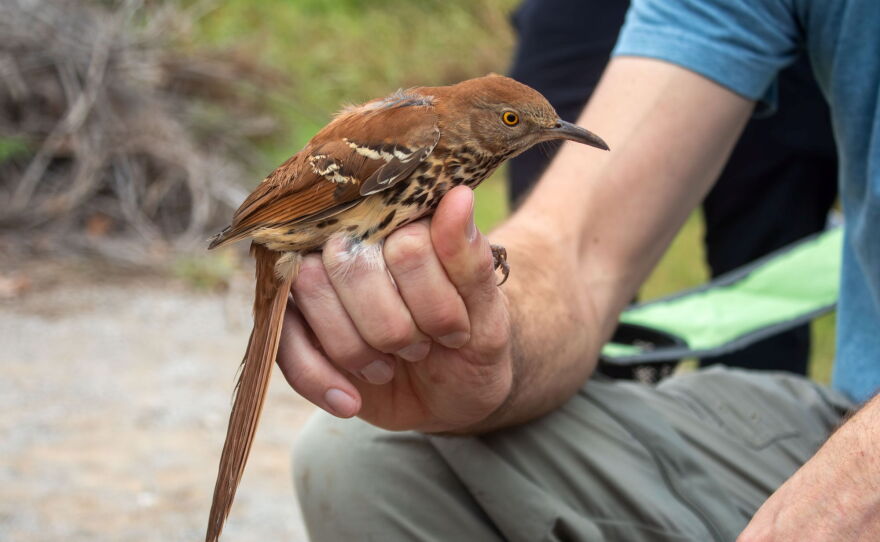
Loss carefully blew back the bird’s feathers to search its small body for ticks. He and his team from Oklahoma State University are tracking the tiny parasites to better understand the spread of tick-borne diseases, which have been on the rise.
“We checked the whole body for ticks,” Loss said. “The common knowledge had been that most ticks are around the head and ears because that's where a bird can't reach with its bill, but we found in our research that the tick could be literally anywhere on the bird.”

Ticks have been around for millions of years. But environmental changes brought on by humans are making it easier for the blood-sucking critters to thrive. Land development, climate change and shifts in wildlife populations have helped boost tick populations, according to Michigan State University entomologist Jean Tsao.
"We've made it better for ticks," Tsao explained.
An estimated 31 million Americans are bitten by ticks each year. And a percentage of those later develop tick-borne illnesses and other health conditions, including Lyme disease and alpha-gal syndrome – the latter of which can result in potentially life-threatening allergic reactions to red meat and dairy products. Emergency room visits for tick bites reached a nine-year high across much of the nation this spring, according to the U.S. Centers for Disease Control and Prevention.
Loss said understanding where these ticks come from and which animal species carry them is key to tackling the diseases they spread. That’s why the Oklahoma ecologist is tracking how ticks are using birds as hosts, which is a relatively new field of research.
“If you really want to understand the whole system, you have to understand the hosts,” he said.


‘They are tenacious’
Ticks thrive in shady spots with plenty of moisture, but they can also survive in less-than-ideal conditions.
“Ticks, once they have really gotten to an area, they are tenacious,” Tsao said. “It's very difficult to get rid of them.”
Suburban development has brought people closer to wildlife habitats, Tsao said, and increased the number of trees, bushes and leaf litter piles where ticks can reproduce.
Human-driven shifts in wildlife populations and invasive species have also allowed ticks to multiply.
Europeans brought feral hogs to the U.S. in the 1500s, and now the pigs' growing populations are estimated to be more than 6 million nationwide. The swine can be heavily infested with a variety of tick species, including the lone star tick.
Invasive eastern redcedar trees that have overtaken much of the Great Plains create prime, humid habitat conditions under their branches, which allow ticks to survive for longer periods until they’re able to find an animal to bite.
A huge surge of white-tailed deer in recent decades has also supported more ticks. Wildlife departments and conservation laws helped to bring the species back after populations fell sharply due to overhunting and habitat changes in the early 1900s. A single white-tailed deer can carry thousands of young and adult ticks.
Another factor complicating tick management is climate change, said Goudarz Molaei, a Yale University professor and director of Connecticut’s state tick surveillance and testing program.
Climate change is spurring warmer temperatures and more extreme weather, which affects vegetation, wildlife and people’s behavior – basically, everything that interacts with ticks.
“It is very naive for us to believe that climate change is going to impact one thing, and that's it,” Molaei said.
For example, ticks are more active during milder and shorter winters. And climate change is shrinking the number of cold days in many places.


Although some state and federal agencies are investing millions to develop tick control methods, Molaei said the public cannot expect the government to shoulder the responsibility for this massive problem alone.
“But government agencies, they have to teach the public how to protect themselves, how to manage their habitats so that they reduce their risk of exposure to tick bites,” Molaei said.
Tsao said to get the resilient critters under control, it’s going to take collective action.
“I think public health folks need to be working with the wildlife management agencies, but also, local communities have to decide what's important for them, too,” she said.
And the work of scientists, like Scott Loss’ research on birds carrying ticks in Oklahoma, is also adding to the understanding.

Still more to uncover
Danielle Brosend, an Oklahoma State University Ph.D. student, is helping Loss track ticks.
She enjoys guiding younger students through the process. Most people do not get to hold a bird, let alone study them, she said.
“A lot of them are like, ‘Oh, birds have ticks? That's crazy,’” Brosend said. “It’s really interesting that they can see it at a different scale and actually kind of get to interact with the birds in a safe way.”

Loss plans to include more students in his research. Next year, they’ll take blood samples from birds to check for tick-borne pathogens.
And there’s still a lot to uncover.
“We are finding different combinations of ticks and pathogens in ticks on the birds that we're sampling here than have been ever found before,” Loss said.
This story was produced in partnership with Harvest Public Media, a collaboration of public media newsrooms in the Midwest and Great Plains. It reports on food systems, agriculture and rural issues.
